No products in the cart.

Puerto Vallarta Downhill & Freestyle 2026
I had seen photos of it online before — bikes blurring through cobblestone alleyways, crowds pressed against colonial walls, the ocean glinting in the background. But nothing quite prepared me for standing there in person as the Puerto Vallarta Downhill & Freestyle 2026 roared to life around me.
I arrived on location on May 1st not entirely sure what to expect. Riders were walking the course in the morning, tracing lines through narrow alleyways and steep stair sets, studying every crack in the concrete. There was something almost meditative about watching them pace it out on foot — knowing that in a matter of hours, they’d be flying down those same streets at terrifying speed. Mexico News Daily
That’s when I noticed him. Among the pros, helmets on, studying the technical drops and staircase sections, was a kid. Not a teenager — a kid. Eleven years old. His name was Weston Lukens, and he was walking the same course as Rémy Métailler, Nicholi Rogatkin, and Sam Pilgrim, studying it with the same focused intensity as riders twice — sometimes three times — his age. I remember thinking: he’s going to actually race this thing. And he did.
A Course Built for the Bold
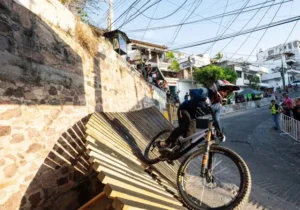 What makes this competition unique is its setting. The historic center of Puerto Vallarta serves as the perfect stage thanks to its steep slopes, which begin high in the Sierra Madre foothills surrounding the city and culminate at the iconic malecón. The 900-meter urban circuit winds through traditional alleyways of the historic center, iconic staircases, and a dramatic final stretch along the Malecón facing the Pacific. The track was not assembled haphazardly — the technical design was handled by international specialists Ollie Wilkins, Christian Fairclough, and Liam Mason, all of whom brought deep experience from high-level global events. Gay Puerto Vallarta + 2
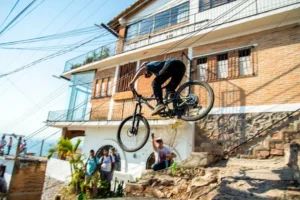 This is not a beginner’s course. There is no forgiving runoff. No gentle gradients. It is steep, narrow, and unforgiving — and watching every single rider fly through it with total commitment was breathtaking. The passion in this event is unlike anything I’ve experienced at a sporting event. It isn’t just athletic performance — it’s an art form. Every descent felt like watching someone do something that shouldn’t be physically possible, and I loved every second of it.
The Kid Who Stole the Show
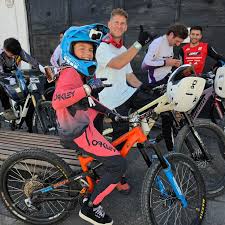 The standout mention among the competitors was 11-year-old Weston Lukens, whose participation drew particular attention. I was standing near one of the tighter alleyway sections when he came through, and I genuinely held my breath. He was tucked low, reading the course, hitting his lines — not surviving it, but riding it. Around me, strangers started murmuring. People pulled out their phones. A woman next to me just shook her head slowly and laughed in disbelief. Meridiano Vallarta
Here was a child competing alongside some of the most accomplished urban downhill riders on the planet, on a course that would give most adults pause. He didn’t just show up — he belonged there. That moment, more than any podium finish, captured everything I love about this sport: the raw passion, the fearless commitment, the proof that talent has no age limit.
The Women Who Commanded the Course
I want to be clear about something: the women’s field at this event was not a sideshow. It was a highlight. Athletes Ana Julia Gutiérrez, Chelsea Kimball, and Hannah Bergemann each brought something distinct and electrifying to the course. Watching them fly through the same brutal 900 meters — the same tight corners, the same unforgiving staircase drops, the same cobblestoned alleyways — with precision and fearless aggression was one of the most exciting athletic exhibits of the entire weekend. The crowd around me erupted just as loudly for them as for anyone else. They deserved every bit of it. These women are not just participants in this sport — they are pushing its boundaries, and seeing them race through the streets of Puerto Vallarta with that level of skill and passion left me truly inspired. Meridiano Vallarta
Star Riders and an Unforgettable Final
The field included internationally recognized figures such as Tomáš Slavík, Sam Pilgrim, Bienvenido Aguado, Nicholi Rogatkin, Antoine Bizet, Rémy Métailler, Kilian Bron, and Johny Salido, representing countries including the Czech Republic, France, Spain, the United States, Canada, Colombia, Chile, Argentina, Greece, and Mexico. La Crónica de Hoy México
The talent on display was staggering — not just in terms of speed, but in the sheer athleticism and creativity each rider brought to the course. I kept finding myself cheering, while not wanting to miss filming any of it with my phone on “slow-mo” mode, so I could replay every move. The adrenaline in the air was contagious. You didn’t need to be a cycling fan to feel it — you just needed a pulse.
France’s Rémy Métailler put together an explosive yet controlled run, crossing the line in 1 minute, 21.41 seconds — a benchmark that almost didn’t hold. Portugal’s Pedro Ferreira came within just six hundredths of a second, stopping the clock at 1:21.47. Then came the loudest roar of the day: Mexico’s Raymundo Fournier surged into third with a 1:22.26, electrifying the crowd. Mexico News Daily
On the freestyle side, American Nicholi Rogatkin claimed the top spot, with Spain’s Bienvenido Aguado finishing second and earning recognition for best trick. Britain’s Sam Pilgrim rounded out the podium in third. Meridiano Vallarta
More Than Just a Race
What I didn’t expect was how much heart the event had off the course. The competing athletes held free clinics for young local riders — kids who got to share space and learn directly from some of the best in the world. That’s the kind of thing that changes a sport’s trajectory. The kids in those clinics saw someone their age on the same start ramp as the world’s elite. That matters more than any trophy. Contralinea
The scale of the event was staggering. More than 15,000 people attended across the two days, with hotel occupancy hitting 90% across the destination. The event received extensive international media coverage through ESPN, Fox, Disney+, National Geographic, Televisa, and TV Azteca. Puerto Vallarta didn’t just host this event — it absorbed it, made it its own. Meridiano VallartaLa Crónica de Hoy México
I left sunburned, hoarse from cheering, heart still racing. The passion, the adrenaline, the extraordinary athletic talent on display — men, women, and yes, one unforgettable 11-year-old — made this one of the most memorable sporting experiences of my life. A new edition is already being planned as part of the international Downhill & Freestyle calendar. I’ll be there. And something tells me Weston Lukens will be too — only faster. Contralinea